
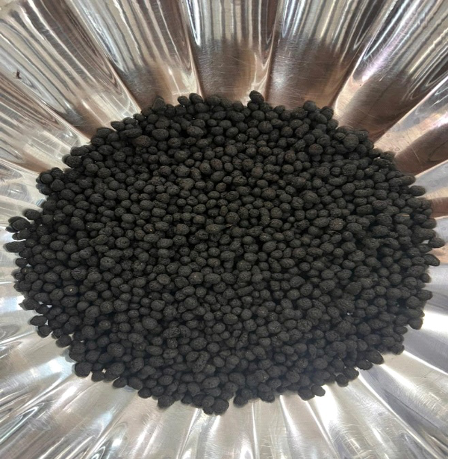
Researchers at NM-AIST have created a patented seaweed-based fertilizer that transforms untapped marine resources into a potential answer for sustainable agriculture.
The Challenge: Turning a Coastal Problem into an Agricultural Opportunity
Large amounts of inedible seaweed can accumulate on the coast of Tanzania, creating environmental problems and affecting the livelihoods of coastal communities.
Simultaneously, reduced soil fertility is still a threat to farmers, enhancing the demand for sustainable and locally available agricultural inputs.
This question was the seed for an innovation to turn neglected marine resources into a valuable agricultural product.
With this knowledge in mind, researchers at the Nelson Mandela African Institution of Science and Technology (NM-AIST) saw an opportunity to link the coast to the farm: What if we could transform underutilized seaweed into a valuable fertilizer to improve agricultural soils?
From Research to Innovation
The research commenced in 2024 and is being spearheaded by Shengelo Edward Manga, in collaboration with Dr. Ruth Lorivi Moirana and Prof. Ernest Rashid Mbega, from the School of Life Sciences and Bioengineering (LiSBE), NM-AIST.
The team looked at six species of inedible seaweed found on the coast of Tanzania, and examined their nutrient make-up and naturally occurring plant-growth hormones.
The most promising nutrient characteristics and availability among the studied species were distinguished in Sargassum.
The researchers then applied these findings to develop a processing method for converting the selected seaweed into granulated organic fertilizer.
The innovation, developed in 2025, showed how a locally available marine resource could be converted into a potentially useful input for agriculture.
The Innovation: Transforming Seaweed into Soil Nutrients
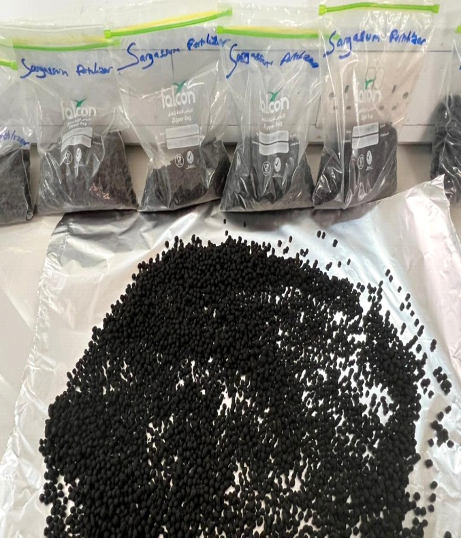
The innovation, titled “A Method of Formulation of Seaweed-Based Granulated Organic Fertilizer,” transforms underutilized seaweed into small, nutrient-rich granules intended to enhance soil fertility.
The granulated formulation, compared to liquid fertilizers, is designed to release nutrients gradually, and thus provide a more sustained supply of nutrients to the soil.
The fertilizer contains organic carbon and essential plant nutrients such as nitrogen, phosphorous and potassium which are important for soil health and plant growth.
Tests performed in the laboratory on the formulation showed:
– 28.93% organic carbon, adding organic matter to the soil.
– Total nitrogen 3.4% an important nutrient for plant growth.
– 9.1% phosphorus pentoxide (P2O5) which is a measure of its phosphorus content.
– 9.47% potassium oxide (K2O) this is the potassium part.
Coupled with naturally occurring compounds derived from seaweed, the innovation presents a promising approach for sustainable soil fertility management.
#Why It Matters Connecting the Blue Economy and Agriculture
This innovation could create value across a range of sectors
It could serve as an alternative organic fertilizer for farmers to enhance soil fertility and sustainable crop production.
It offers an opportunity for coastal communities and seaweed collectors to generate economic value from currently underutilized marine biomass.
The technology offers opportunities for the development of locally produced bio-based fertilizer products for agricultural input manufacturers and entrepreneurs.
Productive use of accumulated seaweed can help mitigate coastal biomass-management challenges, while supporting circular-economy practices, environmentally.
The innovation turns the marine resources into agricultural inputs and shows how scientific research can link the blue economy in Tanzania with sustainable land-based production.
From Lab Research to a Patented Innovation
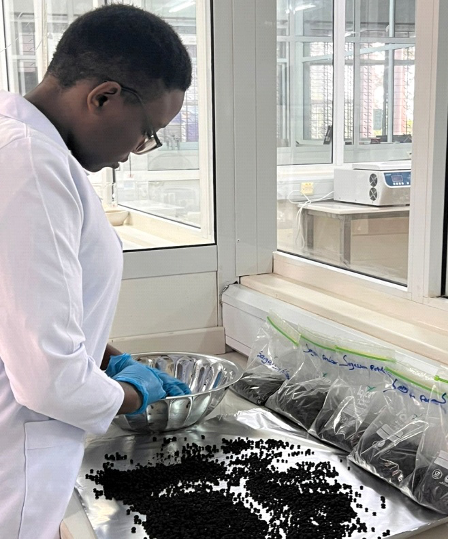
The research has progressed through prototype development and lab testing.
The researchers evaluated the effects of the fertilizer on soil properties in a four-week laboratory soil incubation experiment using different application rates of the fertilizer.
Results showed improvements of some soil fertility indicators such as organic carbon, total nitrogen, available phosphorus and exchangeable potassium.
The results provide a promising basis for future research on possible agricultural applications of the fertilizer.
NM-AIST is the patent owner and the innovation was granted a patent protection in 2026 with registration number TZ/P/2026/000024.
The research was funded by the Remediate Project. Shengelo Edward Manga was awarded the Top Student in Research and Innovation among master’s students at LiSBE in 2026.
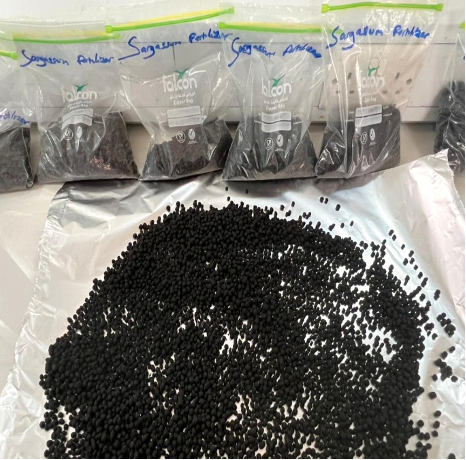
These achievements demonstrate the contribution of young researchers to the growing innovation portfolio of NM-AIST.
What’s Next? From the Laboratory to the Farmers’ Fields
Having completed the laboratory testing and obtained the patent, the next step is to test the fertilizer under real farming conditions.
The research team will carry out field trials to determine the response of various crops to the formulation, to establish appropriate application rates and its agricultural efficacy.
Further work will also look at production feasibility, regulatory requirements and opportunities for commercialization.
In the longer term the ambition is to develop a locally produced, organically produced fertilizer to support sustainable farming while adding economic value to Tanzania’s coastal resources.
This innovation is another example of how NM-AIST is showing how scientific research can turn environmental issues into practical opportunities for sustainable development.
Innovation at a Glance
| Innovation | Seaweed-Based Granulated Organic Fertiliser |
| Lead Innovator | Shengelo Edward Manga |
| Research Team | Dr. Ruth Lorivi Moirana and Prof. Ernest Rashid Mbega |
| Institution | Nelson Mandela African Institution of Science and Technology (NM-AIST) |
| School | Life Sciences and Bioengineering (LiSBE) |
| Research Started | 2024 |
| Year Developed | 2025 |
| Sector | Agriculture, Environmental Conservation, Biotechnology and Blue Economy |
| Primary Raw Material | Sargassum seaweed |
| Patent Title | A Method of Formulation of Seaweed-Based Granulated Organic Fertilizer |
| Patent Number | TZ/P/2026/000024 |
| Patent Granted | 31 July 2026 |
| Patent Owner | NM-AIST |
| Development Stage | Prototype developed and laboratory-tested |
| Research Support | Remediate Project |
| Next Stage | Field validation and commercialisation planning |
| Potential Beneficiaries | Farmers, coastal communities, agricultural cooperatives and fertiliser manufacturers |
Come work with us
NM-AIST is looking to collaborate with agricultural research institutions, fertilizer manufacturers, industry partners, investors, government agencies and development organizations interested in taking this innovation forward.
Current partnership opportunity: Assistance in field validation, product development, production feasibility studies and commercialization of the patented technology.
Transforming Tanzania’s coastal resources into healthy soils and sustainable agriculture opportunities.