
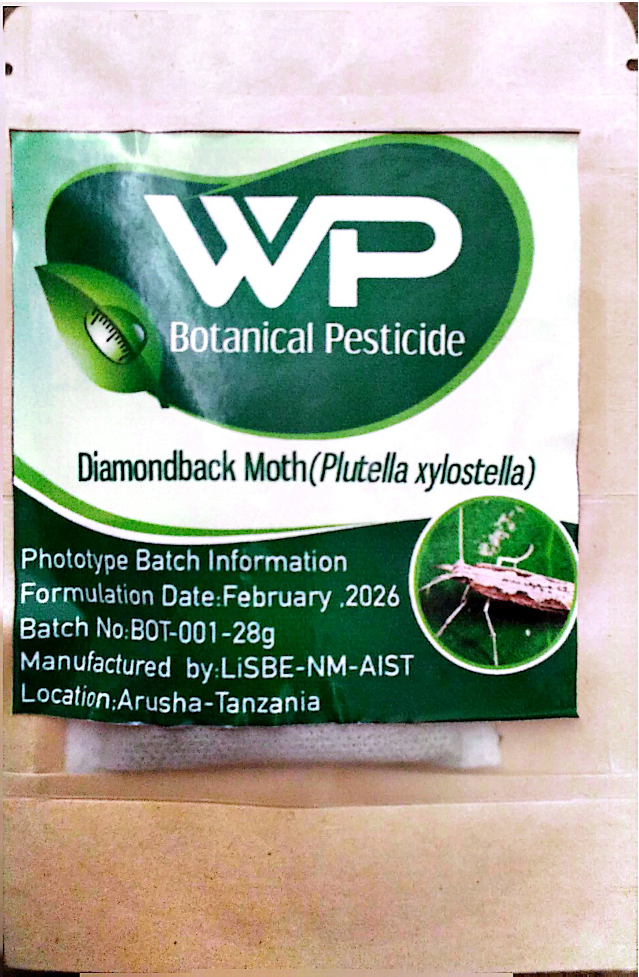
NM-AIST plant researchers have developed a botanical pesticide from the extracts of three plants, a promising locally developed solution for sustainable vegetable production.
The challenge Saving farmers from crop pests that devastate crops
For many vegetable growers in Tanzania, pests on crops are a big problem affecting productivity, income and food production.
Diamondback moth (Plutella xylostella) One of the most destructive pest. They attack cabbage and other leafy vegetables causing damage to crops and decreasing the market value.
These pests are commonly controlled by farmers using synthetic insecticides. However, the rising resistance of insecticides, the concerns on chemical residues and environmental contamination, and the rising cost of pest management have increased the need for alternative solutions.
Tanzania offers a wide diversity of plants with natural insecticidal properties but farmers have limited access to commercially formulated botanical pesticides.
Researchers at the Nelson Mandela African Institution of Science and Technology (NM-AIST) attempted to fill this gap by inquiring into the possibility of transforming locally available plants into an effective and practical product for crop protection.
From Traditional Knowledge to Scientific Innovation
That research journey started in 2023 led by Ambrose A. Ghwanga and Dr. Angela G. Mkindi, Prof. Musa A. Chacha, Dr. Richard Giliba, Prof. Stevenson Belmain and Prof. Phil Stevenson, from NM-AIST’s School of Life Sciences and Bioengineering (LiSBE), and collaborating institutions.
The team looked at three plants known for insecticidal properties, using traditional knowledge of pesticidal plants and the challenges faced by vegetable farmers.
– Tephrosia vogelii
– Allium sativum (garlic)
– Annona squamosa (sugar-apple)
The researchers isolated naturally occurring compounds from these plants and tested how effective they were against diamondback moth larvae.
Instead of using only one plant, they tested mixtures of the three extracts to see if the combined action would improve pest control.
Laboratory experiments showed this combination of three plants to be especially promising, and a wettable powder formulation was developed that could be mixed with water and applied with conventional spraying equipment.
Developed in 2026, the innovation represented a major milestone in transforming botanical research into an actual agricultural product.
Innovation: One Crop Protection Solution in Three Plants
The innovation is titled “A Composition and Methods for Making a Wettable Powder Botanical Pesticide.” The innovation is a plant-based pesticide for controlling diamondback moth larvae on cabbage and related vegetable crops.
The technology is a powder formulation made from extracts of three insecticidal plants that can be mixed with water and sprayed on crops.
The formulation also contains rice husk ash, an agricultural by-product, pointing to another possibility of using locally available materials.
Its main features are:
Ingredients of vegetable origin: The formulation is composed of naturally occurring compounds derived from plants known to have insecticidal properties.
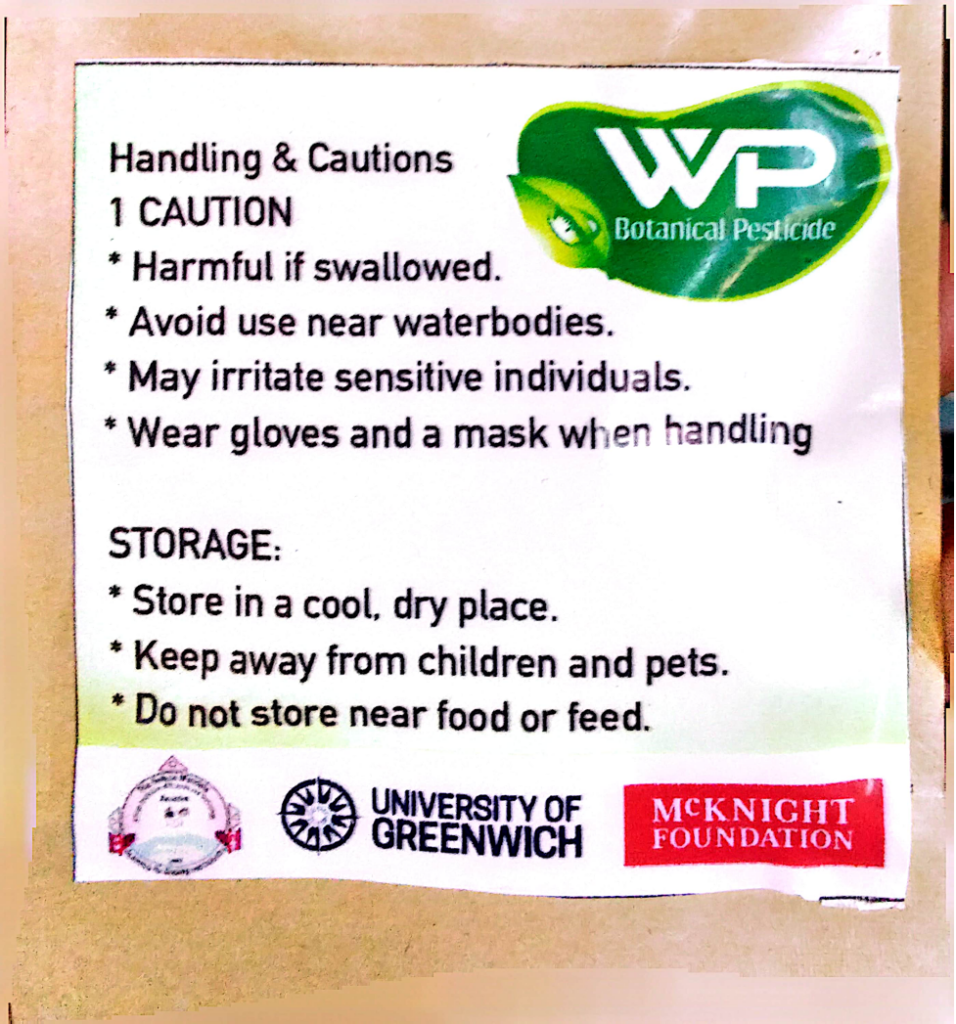
Joint botanical action: The three extracts are put together to provide a wider formulation approach than using one plant extract.
Application: The powder is designed to be dispersed in water and can be applied using standard agricultural spraying equipment.
Use of local resources: Local agricultural input opportunities are provided by the use of plant materials and rice husk ash.
The innovation is intended to provide farmers with another tool for pest management, pending further confirmation that it is effective, safe, affordable and meets regulatory requirements.
Why It Matters: Supporting More Sustainable Vegetable Farming
Commercialization, registration and successful validation of the botanical pesticide could bring a number of benefits to the agricultural sector in Tanzania.
It may provide an additional alternative for smallholder and commercial vegetable farmers to manage damaging pests and reduce reliance on conventional synthetic insecticides.
It offers agricultural input producers the chance to develop botanical crop-protection products locally.
The innovation could help researchers and agricultural extension services in their larger efforts to promote integrated pest management and sustainable crop production.
The use of rice husk ash also shows how agricultural by-products can be incorporated into new technologies, promoting circular-economy practices.
The technology could also be used for other cruciferous vegetables, such as kale and Chinese cabbage, after further testing, in addition to cabbage cultivation.
From Lab Experiments to Promising Field Results
Botanical extraction, laboratory testing, formulation development and field evaluation have been carried out on the innovation.
Laboratory tests at the World Vegetable Center in Tanzania showed promising activity against diamondback moth larvae.
The results, as reported by the research team, showed that the three-plant formulation resulted in:
– 88.3% larval death after 72 hours with the 30% formulation.
– 91.7% larval mortality after 72 h with the 45% formulation.
Under the reported laboratory conditions, the reference synthetic insecticide, Cutter 112EC, achieved a 98.3% mortality in comparison.
The technology was also tested in a cabbage field trial at the Arusha Technical College Irrigation Farm between July and September 2026.
Researchers reported promising field results, with the 30% and 45% wettable powder formulations achieving 80% and 85% respectively after six weeks of application compared to 95% for the synthetic reference product.
The synthetic insecticide performed better in these comparisons, but the botanical formulation shows promising potential as an alternative crop-protection option.
The innovation has been granted patent protection on 30 July 2026 with registration number TZ/P/2026/000025. The patent owners are NM-AIST and Arusha Technical College.
The innovation also received support to be showcased at the 2026 National Science, Technology and Innovation Competition (MAKISATU) at Tanga, Tanzania.
What’s Next From Research to the Fields of Farmers
Following laboratory and field evaluations, the next priority is to strengthen the evidence required to advance the innovation toward wider use in agriculture.
The research team plans to do more field validation, improve the stability and shelf life of the formulation, and do the needed safety and quality assessments.
Further work will be undertaken to assess potential impacts on users and the environment and to engage with the appropriate regulatory authorities.
The researchers are also looking for strategic research and industry partners to assist with pilot scale production, product registration and eventual commercialization.
If these steps succeed they could contribute to improving access to locally developed botanical pesticides and to enhancing sustainable vegetable production in Tanzania.
Through this innovation, NM-AIST continues to show how scientific research can transform natural resources and indigenous knowledge into applicable technologies that address national agricultural challenges.
Innovation at a Glance
| Innovation | Wettable Powder Botanical Pesticide |
| Lead Innovator | Ambrose A. Ghwanga |
| Research Team | Dr. Angela G. Mkindi, Prof. Musa A. Chacha, Dr. Richard Giliba, Prof. Stevenson Belmain and Prof. Phil Stevenson |
| Institution | Nelson Mandela African Institution of Science and Technology (NM-AIST) |
| School | Life Sciences and Bioengineering (LiSBE) |
| Research Started | 2023 |
| Year Developed | 2026 |
| Sector | Agriculture, Biotechnology, Crop Protection and Sustainable Farming |
| Core Technology | Three-plant extract wettable powder formulation |
| Target Pest | Diamondback moth (Plutella xylostella) |
| Patent Title | A Composition and Methods for Making a Wettable Powder Botanical Pesticide |
| Patent Number | TZ/P/2026/000025 |
| Patent Granted | 30 July 2026 |
| Patent Owners | NM-AIST and Arusha Technical College |
| Development Stage | Prototype developed; laboratory and field testing completed; further validation required |
| Laboratory Testing | World Vegetable Center, Tanzania |
| Field Evaluation | Arusha Technical College Irrigation Farm |
| Potential Beneficiaries | Vegetable farmers, agricultural input manufacturers and crop-protection stakeholders |
Join Us
NM-AIST encourages collaboration with agricultural research institutions, agro-input manufacturers, biotechnology companies, investors, government agencies and development partners who are interested in promoting this innovation.
Current partnership opportunity: Additional field validation, toxicological and environmental safety assessment, regulatory approval and pilot scale manufacture of the botanical pesticide.
Advancing sustainable crop protection through locally-developed science and innovation.