
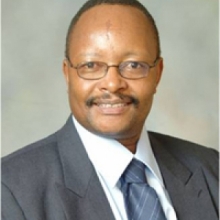
Prof. Karoli N. Njau
Professor
I’m currently a Full Professor of Environment at the Nelson Mandela African Institution of Science and Technology where I train and supervise MSc and PhD students.
Experience & Activities
Prof. Karoli N. Njau is a seasoned Environmental Engineer and Professor at the Nelson Mandela African Institution of Science and Technology (NM-AIST) in Arusha, Tanzania. He holds a PhD in Environmental Engineering from Eindhoven University of Technology in the Netherlands, a Master’s degree in Chemical Engineering from the Norwegian Institute of Technology (NTH), and a Bachelor of Science in Process Engineering from the University of Dar es Salaam.
With extensive academic and research experience, Prof. Njau specializes in environmental systems engineering, wastewater treatment technologies, biogas production, and sustainable water resource management. He has supervised numerous MSc and PhD students and played a key role in regional environmental research projects, including initiatives under BioInnovate Africa, focusing on eco-friendly treatment of industrial wastewater.
Prof. Njau also serves in various academic leadership positions at NM-AIST and contributes to policy and innovation in environmental science across East Africa.
Certificate for Outstanding Research Publications
In May 2024, Prof. Njau was honored by the Prime Minister of Tanzania, Hon. Kassim Majaliwa, during the National Education, Skills, and Innovation Week in Tanga. He received a certificate for his exceptional achievements in publishing research in esteemed international journals.
First Place in Environmental Sanitation (Arusha Region)
In April 2025, the Nelson Mandela African Institution of Science and Technology (NM-AIST), where Prof. Njau serves as a professor, was awarded first place in environmental sanitation for the Arusha Region in the institutional category. The award was presented by the Deputy Prime Minister, Hon. Dr. Dotto Biteko, during the 61st anniversary celebrations of the Union of Tanganyika and Zanzibar.
Project / Initiative | Description |
New integrated methods for industrial wastewater treatment (BioInnovate Africa) | Prof. Njau is team leader of this project. BioInnovate Africa |
Integrated Process for Sustainable Agro Process Waste Treatment and Climate Change Mitigation in Eastern Africa | Multi‑country project (Tanzania, Uganda, Ethiopia, Rwanda) aiming to develop innovative wastewater treatment processes that integrate biogas production and water/nutrient reuse, strengthening the capacity to manage agro‑process wastewater. Envicon |
A regional enterprise to commercialize an integrated technology for wastewater treatment and biowaste conversion in Eastern Africa | Led by Prof. Njau, this project aims to commercialize technologies that take agro/bio‑waste and convert them into useful by‑products (clean water, fertilizer, energy), while treating wastewater to meet environmental standards. Partners include NM‑AIST (Tanzania), Addis Ababa University, Makerere University, iTEC. BioInnovate Africa+1 |
Project at Banana Investment Limited (Arusha, Tanzania) | A full‑scale integrated wastewater‑management system was constructed combining biogas digesters + constructed wetlands so that wastewater from the factory can be treated fully, with treated water reused for irrigation. BioInnovate Africa |
Technology development in constructed wetlands, reactor engineering, smart environmental management | Prof. Njau’s broader work (oversight) includes experimental & applied engineering in constructed wetlands, optimizing reactors, etc., often in connection with the BioInnovate Africa portfolio. BioInnovate Africa+1 |
Banana Centre of Excellence | Related to research on improving banana cultivation (disease/pest resistance, variety improvements) in cooperation with IITA, etc. Prof. Njau is coordinator of projects of the Centre. Ratin |
An Assessment of Monetary Policy Transmission in Kenya
SS Njau - 2022 - erepository.uonbi.ac.ke
The role played by monetary policy towards sustainable economic outcomes cannot be
refuted. Kenyan government through Central bank implements various monetary policies to …
Save Cite Related articles
…, NA Amuri, PA Ndakidemi, KM Mtei, KN Njau - Frontiers in …, 2024 - frontiersin.org
In the northern part of Tanzania, the slopes of Mount (Mt.) Kilimanjaro are the most important
areas, both in terms of socio-economic development and ecological succession. The main …
Save Cite Cited by 1 Related articles All 5 versions
…, A Hilonga, RL Machunda, KN Njau - Sustainable Environment …, 2019 - Springer
Recently, there are increased efforts by municipals and researchers to investigate the
potential of utilizing municipal solid wastes (MSW) for resources recovery. In many parts of …
Save Cite Cited by 61 Related articles All 13 versions
Pumice soil: a potential wetland substrate for treatment of domestic wastewater
KN Njau, RJA Minja, JHY Katima - Water Science and Technology, 2003 - iwaponline.com
Laboratory and fieldwork studies were carried out to evaluate the potential of pumice soil for
use as a wetland substrate in wastewater treatment. The composition of pumice soil was …
Save Cite Cited by 71 Related articles All 11 versions
Approaches to the mitigation of ammonia inhibition during anaerobic digestion–a review
E Mutegoa, A Hilonga, KN Njau - Water Practice & Technology, 2020 - iwaponline.com
… Eric Mutegoa, Askwar Hilonga, Karoli N. Njau; Approaches to the mitigation of ammonia
inhibition during anaerobic digestion – a review. Water Practice and Technology 1 September …
Save Cite Cited by 31 Related articles All 7 versions


 Visit Today : 563
 Visit Yesterday : 2174
 This Month : 17936
 This Year : 194580
 Total Visit : 881846